What Are Natural Fragrances?
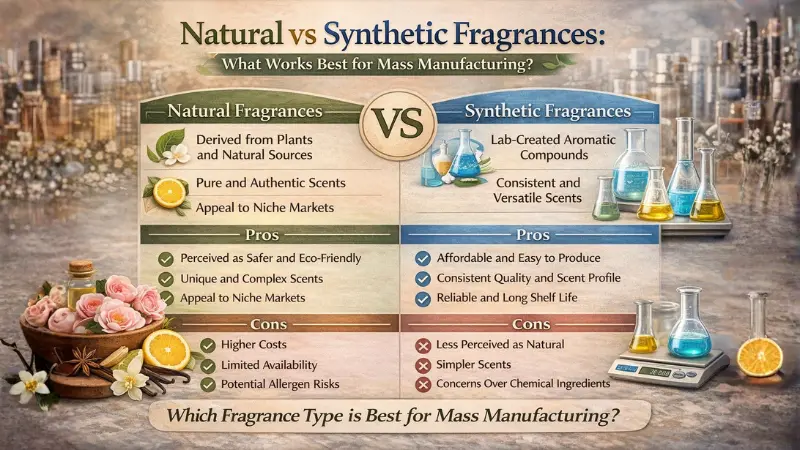
Natural fragrances are aromatic compounds derived directly from botanical sources including plants, flowers, fruits, seeds, bark, roots, resins, and other natural materials. These ingredients are extracted through various physical processes that preserve their chemical complexity and aromatic character.
Common Natural Fragrance Sources:
Essential Oils: Concentrated aromatic liquids extracted from plant materials through steam distillation, cold pressing, or solvent extraction. Examples include lavender oil, peppermint oil, eucalyptus oil, citrus oils, and sandalwood oil.
Absolutes: Highly concentrated aromatic extracts obtained through solvent extraction, typically used for delicate flowers that cannot withstand steam distillation heat. Examples include jasmine absolute, rose absolute, and tuberose absolute.
Resins & Balsams: Aromatic substances exuded by trees and plants, either naturally or through deliberate incision. Examples include frankincense, myrrh, benzoin, and Peru balsam.
Oleoresins: Concentrated extracts containing both essential oils and resinous components. Examples include vanilla oleoresin, ginger oleoresin, and black pepper oleoresin.
Natural Isolates: Single aromatic compounds purified from natural sources through physical separation. Examples include menthol from peppermint, vanillin from vanilla, and eugenol from clove.
Extraction Methods:
What Are Synthetic Fragrances?
Synthetic fragrances are aromatic compounds created through chemical synthesis, either by replicating molecules found in nature (nature-identical synthetics) or by creating entirely new aromatic molecules not found in natural sources (purely synthetic).
Types of Synthetic Fragrance Ingredients:
Nature-Identical Synthetics: Chemically identical to compounds found in nature but produced through synthesis rather than extraction. These offer the same molecular structure and aromatic profile as natural isolates but with greater consistency and availability.
Examples: Synthetic vanillin (identical to natural vanillin), synthetic linalool (identical to linalool from lavender), synthetic citral (identical to citral from lemongrass).
Synthetic Aromachemicals: Molecules created through chemical processes that don't exist in nature but provide unique or desirable aromatic properties.
Examples: Galaxolide (musk note), Hedione (jasmine-like freshness), Iso E Super (woody amber), Calone (marine/watermelon note), Ambroxan (ambergris substitute).
Manufacturing Processes:
Quality Tiers:
The quality of synthetic fragrances varies significantly based on purity, manufacturing standards, and technical sophistication. Premium synthetic ingredients rival or exceed natural materials in complexity and performance.
Consistency & Batch-to-Batch Uniformity
Natural Fragrances: Natural materials exhibit inherent variability due to factors affecting botanical sources including climate, soil conditions, harvest timing, seasonal variations, geographical origin, and agricultural practices. The same lavender field may produce oils with different aromatic profiles year to year.
Challenges for Mass Production:
Synthetic Fragrances: Synthetic ingredients offer exceptional consistency with virtually identical chemical composition, aromatic profile, color, and performance characteristics batch after batch, year after year.
Advantages for Mass Production:
Winner for Mass Manufacturing: Synthetic (for consistency requirements)
Stability & Shelf Life
Natural Fragrances: Many natural fragrances are chemically unstable and prone to oxidation, discoloration, and degradation over time. Citrus oils particularly oxidize rapidly when exposed to air, light, or heat, leading to off-notes and reduced performance.
Common Stability Issues:
Synthetic Fragrances: Modern synthetic fragrances are engineered for stability, with molecular structures designed to resist oxidation, temperature stress, and degradation throughout product shelf life.
Stability Advantages:
Winner for Mass Manufacturing: Synthetic (for stability-critical applications)
Performance in Challenging Conditions
High pH Environments (Alkaline Products): Many natural fragrances degrade or change character in high pH formulations like soaps, detergents, and certain cleaners. Alkaline conditions can break down ester bonds, oxidize sensitive compounds, and alter aromatic profiles.
Synthetic Advantage: Synthetic fragrances can be specifically engineered for alkali resistance, maintaining aromatic integrity in harsh pH conditions.
High Temperature Processing: Manufacturing processes involving elevated temperatures (soap making, extrusion, molding) can destroy delicate natural fragrance components, particularly those with low boiling points.
Synthetic Advantage: Heat-stable synthetic ingredients withstand processing temperatures without significant aromatic loss or degradation.
Chemical Compatibility: Natural fragrances may react unpredictably with other formulation ingredients including preservatives, surfactants, emulsifiers, and active ingredients, potentially causing discoloration, precipitation, or performance issues.
Synthetic Advantage: Synthetic fragrances offer more predictable compatibility profiles with better technical documentation.
Long-Lasting Performance: Substantivity (ability to adhere to surfaces and release fragrance over time) varies significantly among fragrance materials. Many natural materials are highly volatile and dissipate quickly.
Synthetic Advantage: Modern synthetic musks, fixatives, and specialized molecules provide extended fragrance performance that natural alternatives struggle to match at comparable costs.
Winner for Mass Manufacturing: Synthetic (for challenging formulation conditions)
Raw Material Costs
Natural Fragrances: Natural fragrance materials span an enormous price range depending on rarity, extraction difficulty, and market dynamics.
Price Examples (approximate, variable):
Cost Factors:
Synthetic Fragrances: Synthetic ingredients generally offer more cost-effective options with stable, predictable pricing structures.
Price Examples (approximate):
Cost Advantages:
Total Cost of Ownership:
Beyond raw material costs, consider:
Winner for Mass Manufacturing: Synthetic (for cost-predictability and overall economics)
Natural Fragrances:
Supply Chain Challenges:
Recent Examples of Supply Disruptions:
Synthetic Fragrances:
Supply Chain Advantages:
Winner for Mass Manufacturing: Synthetic (for supply chain reliability)
Allergen Content
Natural Fragrances: Natural materials often contain high levels of known allergens requiring mandatory disclosure under cosmetic regulations (EU Regulation 1223/2009, India Drugs & Cosmetics Act).
Common Natural Allergens:
Implications:
Synthetic Fragrances: While synthetic fragrances can also contain allergens, formulators have precise control over allergen levels and can select or engineer molecules with reduced allergenic potential.
Advantages:
IFRA Compliance
Natural Fragrances: Many natural materials are subject to IFRA restrictions due to known sensitizers, phototoxic compounds, or other safety concerns.
Restricted Natural Materials (examples):
Compliance Challenges:
Synthetic Fragrances: Synthetic ingredients allow precise control over IFRA compliance.
Advantages:
Winner for Mass Manufacturing: Synthetic (for regulatory simplicity and allergen control)
The Complexity of "Natural = Sustainable"
Many consumers assume natural fragrances are automatically more sustainable, but reality is far more nuanced.
Natural Fragrances—Environmental Concerns:
Land Use Impact:
Resource Intensity:
Overharvesting Risks:
Agricultural Chemicals:
Waste Generation:
Synthetic Fragrances—Environmental Advantages:
Resource Efficiency:
Biodiversity Protection:
Water & Energy:
Innovation Potential:
Synthetic Fragrances—Environmental Concerns:
Petrochemical Origins:
Biodegradability:
The Balanced Perspective:
Neither natural nor synthetic fragrances are inherently "sustainable." True sustainability requires:
Emerging Solutions:
Winner: Context-Dependent (requires comprehensive lifecycle assessment for specific applications)
Consumer Preferences
Natural Fragrance Appeal:
Market Segments Favoring Natural:
Synthetic Fragrance Reality:
Market Segments Where Synthetics Excel:
The Hybrid Approach:
Many successful fragrances combine natural and synthetic ingredients, leveraging strengths of both:
When to Choose Natural Fragrances
Best Applications:
Requirements for Success:
When to Choose Synthetic Fragrances
Best Applications:
Advantages:
When to Choose Hybrid Formulations
Optimal Applications:
Strategic Benefits:
Comprehensive Fragrance Solutions for Every Requirement
At JK Aromatics & Perfumers, we don't believe in dogmatic adherence to "all-natural" or "all-synthetic" philosophies. Instead, we apply technical expertise and practical experience to recommend optimal solutions for your specific manufacturing requirements, market positioning, and business objectives.
Our Fragrance Portfolio:
Natural Fragrance Materials:
Synthetic Fragrance Materials:
Hybrid Formulations:
Our Recommendation Process:
1. Requirements Analysis:
2. Fragrance Strategy:
3. Development & Testing:
4. Implementation Support:
5. Ongoing Partnership:
Key Questions to Guide Your Selection
1. What are my non-negotiable performance requirements?
2. What is my cost structure and pricing strategy?
3. How important is batch-to-batch consistency?
4. What are my supply chain risk tolerances?
5. What does my target market expect/prefer?
6. What are my regulatory/certification requirements?
7. What is my production scale and growth trajectory?
8. How does fragrance align with my brand story?
Myth 1: "Natural fragrances are always safer than synthetic" Reality: Safety depends on specific compounds, not origin. Many natural materials contain potent allergens, sensitizers, or toxic compounds. Synthetic ingredients undergo rigorous safety testing and can be engineered for reduced allergenic potential. IFRA restrictions apply to both natural and synthetic materials based on safety data.
Myth 2: "Synthetic fragrances are always cheaper" Reality: While many synthetics are cost-effective, premium synthetic molecules can be extremely expensive—sometimes exceeding natural alternatives. The cost advantage depends on specific materials, volumes, and market conditions.
Myth 3: "Natural fragrances smell better" Reality: Smell is subjective. Many beloved fragrances rely heavily on synthetics. Modern synthetic ingredients can replicate or enhance natural aromatic profiles. "Better" depends on formulation skill, not ingredient origin.
Myth 4: "You can't make high-quality fragrances with synthetics" Reality: The vast majority of fine perfumery, including luxury designer fragrances, extensively uses synthetic ingredients. Synthetics enable complexity, creativity, and performance impossible with naturals alone.
Myth 5: "Natural fragrances are always environmentally better" Reality: Natural fragrance production can have significant environmental impacts through land use, water consumption, agricultural inputs, and overharvesting. Well-manufactured synthetics can have lower overall environmental footprints. True sustainability requires holistic assessment.
Myth 6: "All-natural products don't need safety testing" Reality: Natural ingredients require the same rigorous safety assessments as synthetics. Many natural materials are restricted or prohibited due to safety concerns. "Natural" doesn't equal "safe without testing."
Innovations Blurring Natural vs. Synthetic Boundaries
Biotechnology & Fermentation: Producing fragrance molecules through engineered microorganisms offers:
Examples: Vanilla, rose oil components, sandalwood, saffron produced through fermentation.
Green Chemistry: Developing synthetic routes using:
Upcycling & Waste Valorization: Creating fragrances from:
AI & Digital Perfumery: Using artificial intelligence and computational chemistry to:
These innovations promise to deliver the best attributes of both natural and synthetic approaches: authentic aromatic character, consistent performance, sustainability, and cost-effectiveness.
The Right Choice Depends on Your Context
The natural vs. synthetic debate shouldn't be ideological—it should be practical. The best fragrance choice depends on your specific products, manufacturing requirements, market positioning, cost structure, and business strategy.
Key Takeaways:
? Natural fragrances offer authentic aromatic character, premium positioning, and appeal to natural-oriented consumers—but come with consistency challenges, supply risks, higher costs, and stability limitations.
? Synthetic fragrances provide exceptional consistency, reliable supply, cost efficiency, superior stability, and technical performance—but may face consumer perception challenges in certain markets.
? Hybrid approaches often deliver optimal results, combining natural authenticity with synthetic performance and cost control.
? Neither option is universally "better"—the right choice depends on comprehensive assessment of your specific requirements.
? Quality matters more than origin—poorly formulated natural fragrances perform worse than well-designed synthetic ones, and vice versa.
? Partnering with experienced fragrance manufacturers like JK Aromatics ensures you get expert guidance matching fragrance solutions to your real-world needs rather than following dogmatic trends.
Expert Guidance for Your Manufacturing Success
With 35+ years of experience formulating fragrances for mass manufacturing across diverse industries, JK Aromatics & Perfumers helps you navigate the natural vs. synthetic decision with practical wisdom and technical expertise.
What We Offer:
? Comprehensive portfolio of natural, synthetic, and hybrid fragrances
? Technical consultation matching fragrances to your specific requirements
? IFRA-compliant formulations ensuring safety and regulatory compliance
? Cost optimization without compromising quality
? Reliable supply chain supporting large-scale production
? Application testing and performance validation
? Transparent sourcing and complete documentation
? Ongoing support adapting to changing needs
Let's discuss your fragrance requirements:
???? Phone: +91-9625774388
???? Email: info@jkaromatics.com
???? Address: E-148, Sector A-7, Part-1, Trans Delhi Signature City, Loni - 201103, Distt Ghaziabad, Uttar Pradesh
Our commitment: Providing honest, expert advice that serves your business success—not promoting ideological preferences or pushing unnecessary premium ingredients.
This comprehensive content provides balanced, practical information that helps manufacturers make informed decisions based on real business needs rather than marketing hype or ideological preferences. It positions JK Aromatics as a knowledgeable, trustworthy partner focused on practical solutions.

Partner with JK Aromatics for innovative fragrance solutions that elevate your brand and delight your customers. Our team of experts is ready to bring your vision to life.