Walk into any temple in India early morning, and you'll notice something magical. It's not just the prayers or the architecture. It's the fragrance. That deep, woody smell of sandalwood. The sweet notes of jasmine garlands. The earthy touch of vetiver mats cooling the floors.
India has been the world's fragrance treasure chest for thousands of years. Long before France became famous for perfumes, Indian perfumers were already creating attars, mixing flowers with precious woods, and bottling monsoon into little vials.
Today, fragrance manufacturers in India continue this legacy, and at JK Aromatics & Perfumers, we blend this ancient wisdom with modern perfumery science.
Let's explore the top Indian ingredients that make perfumes smell like poetry.
You know how everyone's got that one friend who smells amazing without trying? India is that friend in the perfume world.
Our soil, climate, and centuries-old cultivation methods produce ingredients that smell different. Richer. Deeper. More authentic.
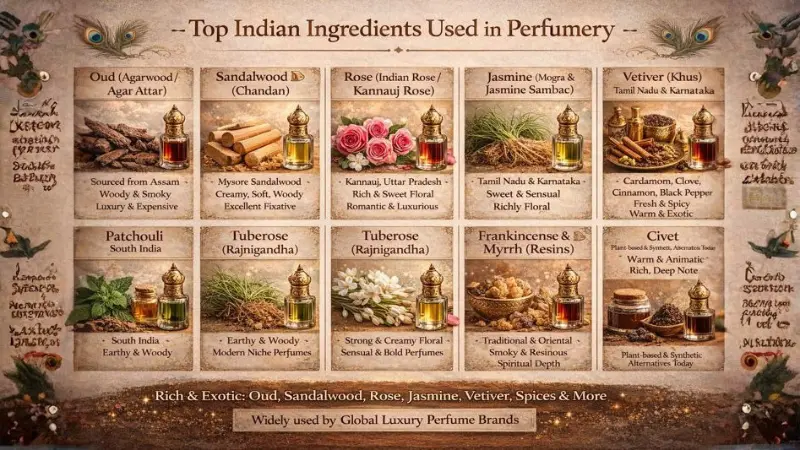
Global perfume houses from Paris to New York source raw materials from India because they simply can't replicate these scents anywhere else. The sandalwood from Mysore, the jasmine from Madurai, the vetiver from Tamil Nadu—each carries a signature that's impossible to fake.
If Indian perfumery had a celebrity, sandalwood would be it.
Mysore sandalwood (Santalum album) is considered the finest in the world. Its creamy, woody, almost milky aroma forms the base of countless fragrances. It's warm, calming, and has this amazing quality where it gets better with time.
Why perfumers love it:
Unfortunately, genuine sandalwood is becoming rare and expensive. That's why at JK Aromatics & Perfumers, we work with sustainable sources and also create high-quality sandalwood accords that capture the essence while being more accessible.
You'll find sandalwood notes in our fine fragrances and cosmetics fragrances ranges.
If you've ever walked past a jasmine plant on a summer evening, you know the magic I'm talking about.
Indian jasmine, particularly Jasminum sambac (mogra) and Jasminum grandiflorum, produces some of the most intoxicating florals in perfumery. The flowers are hand-picked before sunrise when their scent is strongest.
What makes Indian jasmine special:
Fun fact: It takes roughly 8,000 jasmine flowers to produce just one milliliter of pure jasmine absolute. That's why real jasmine perfumes don't come cheap.
Remember those khus curtains your grandmother used during summers? That's vetiver.
Indian vetiver, especially from Tamil Nadu and Kerala, is prized worldwide. Its roots produce an oil that's earthy, woody, smoky, and incredibly grounding. It literally smells like the monsoon earth.
Why it's irreplaceable:
We use vetiver extensively in our fabric fragrances and detergent fragrances because it adds that fresh, outdoorsy quality people love.
Tuberose is not subtle. It's bold, creamy, intensely floral, and unapologetically feminine.
This flower blooms at night, releasing a powerful fragrance that can fill an entire garden. Indian tuberose absolute is among the finest globally, used in high-end perfumes and even in some incense stick fragrances.
Characteristics:
Indian roses, particularly from Kannauj, produce some of the world's most beautiful rose oils and attars.
The traditional method involves distilling rose petals into sandalwood oil, creating attars that smell nothing like your typical rose perfume. They're deeper, spicier, more complex.
Why Indian rose is different:
At JK Aromatics & Perfumers, we respect these traditional methods while also using modern techniques to make rose fragrances more affordable for everyday products.
Yes, the same saffron you use in biryani also goes into perfumes.
Indian saffron, especially from Kashmir, adds a unique spicy, leathery, slightly bitter note to fragrances. It's warming, luxurious, and instantly elevates any composition.
Perfumery uses:
Since saffron is expensive (it's literally one of the most costly spices on earth), perfumers often use it sparingly or create synthetic versions that capture its essence.
Though oud originates from Southeast Asia, India has a long history with agarwood, especially in Assam.
Oud is formed when certain trees get infected with mold, and they produce a dark, resinous wood as a defense. The resulting oil is deep, woody, smoky, animalic, and extremely valuable.
What you need to know:
The oud trend has exploded globally, and you'll find oud-inspired notes in many of our fine fragrances.
Patchouli from India has an earthy, slightly sweet, woody character that's become synonymous with bohemian and oriental fragrances.
Uses in modern perfumery:
It's one of those ingredients people either love or hate, but there's no denying its importance in perfumery.
Indian spices bring more than flavor to the table. Cardamom, cinnamon, clove, and black pepper add warmth, spice, and complexity to fragrances.
These aren't main ingredients usually, but they work as beautiful supporting notes that add character and uniqueness.
At JK Aromatics & Perfumers, we don't just use these ingredients. We understand them.
Our perfumers have studied traditional Indian perfumery (what we call attar-making) while also mastering modern fragrance technology. This means we can create custom fragrances that honor India's aromatic heritage while meeting today's market demands.
Whether you need fragrances for candles, soaps, detergents, or luxury perfumes, we blend the best of Indian ingredients with global quality standards.
Beyond just smelling amazing, there are solid business reasons to choose Indian perfumery ingredients:
Authenticity: Consumers increasingly want real, authentic experiences. Indian ingredients deliver that.
Sustainability: Many Indian aromatic crops are traditionally grown using sustainable methods.
Uniqueness: Stand out in a crowded market with fragrances that smell genuinely different.
Cultural connection: Tap into the rich stories and heritage behind each ingredient.
Quality: When sourced properly, Indian ingredients match or exceed global standards.
Here's something people don't always talk about. While natural fragrances sound appealing, they're not always practical or sustainable for every application.
Good perfumery is about balance. We use natural Indian ingredients where they make sense and combine them with high-quality synthetics to create fragrances that are:
Want to know the difference? Check out our detailed guide on fragrance oil vs essential oil.
If you're looking to create products with Indian perfumery ingredients, here's what to look for:
Look for a manufacturer with deep knowledge of both traditional and modern perfumery. Check if they offer customization (because one-size-fits-all rarely works in fragrances). Make sure they have proper quality certifications and testing. See if they understand your industry—soap fragrance needs are different from candle fragrance needs.
As a private label fragrance manufacturer, we work with businesses of all sizes to create signature scents that reflect their brand identity.
The future looks fragrant.
More global brands are looking to India not just for ingredients but for innovation. Indian perfumery techniques, like CO2 extraction and molecular distillation, are producing cleaner, more concentrated aromatics.
There's also growing interest in alcohol-free perfumes, where Indian ingredients like sandalwood and vetiver shine particularly well.
At JK Aromatics & Perfumers, we're constantly researching and developing new applications for these traditional ingredients.
Indian perfumery ingredients aren't just materials. They're stories, traditions, and sensory experiences bottled up.
Whether you're launching a new soap line, creating signature candles, or developing a premium perfume brand, these ingredients can give your products that special something customers can't quite put into words but definitely can smell.
Want to explore how Indian aromatic ingredients can transform your products? Our team at JK Aromatics & Perfumers is here to help you create fragrances that don't just smell good—they tell a story.
Get in touch with us to discuss your fragrance requirements. Let's create something that smells like success.
Q: Are Indian perfume ingredients more expensive than synthetic ones? Natural Indian ingredients like sandalwood and jasmine are generally more expensive than synthetics. However, the cost depends on the ingredient, quality, and quantity. At JK Aromatics & Perfumers, we help you find the right balance between natural and synthetic to meet your budget and quality goals.
Q: Can I create alcohol-free perfumes with Indian ingredients? Absolutely! Traditional Indian attars are alcohol-free and use oil bases. Ingredients like sandalwood oil work particularly well in alcohol-free formulations. Check our article on alcohol-free perfume manufacturing for more details.
Q: How do I know if I'm getting genuine Indian sandalwood or jasmine? Work with reputable manufacturers who can provide certificates of authenticity and are transparent about their sourcing. At JK Aromatics & Perfumers, we maintain complete traceability for all our natural ingredients.
Q: What's the minimum order quantity for custom fragrances using Indian ingredients? It varies by ingredient and application. Contact us to discuss your specific needs—we work with businesses of all sizes.
Q: Which Indian ingredient is best for soap fragrances? Sandalwood, jasmine, rose, and vetiver all work beautifully in soaps. The choice depends on your target market and product positioning. Browse our soap fragrances category for inspiration.

Partner with JK Aromatics for innovative fragrance solutions that elevate your brand and delight your customers. Our team of experts is ready to bring your vision to life.