Last month, I met a startup founder who spent ?3 lakhs developing a "luxury" candle line. She was excited, the packaging looked gorgeous, and the scent in the lab smelled amazing.
But when customers started burning the candles? Disaster. The fragrance disappeared after 20 minutes. Returns flooded in. The entire batch became a loss.
Her mistake? She assumed fragrance formulation was just about making things smell nice. It's not.
I've watched dozens of small brands make similar mistakes over the years. Some recover. Many don't. The fragrance industry has a learning curve, and those lessons can get expensive fast.
Want to skip the painful mistakes? Let me show you the ten biggest errors small brands make with fragrance formulation—and more importantly, how to avoid them.
This is the big one. The mistake that leads to all other mistakes.
I get it. You're a small brand. Money's tight. Hiring a professional perfumer or working with an established fragrance manufacturer in India feels expensive upfront.
So you try to DIY it. You buy some essential oils online, mix them in your kitchen, and hope for the best.
Here's what happens: Your formulations are unstable. Your scents don't last. Your products separate or discolor. You have no idea about safety regulations. And when something goes wrong, you have no expert to call.
The Real Cost: That ?50,000 you "saved" by avoiding professionals becomes ?3 lakhs in wasted inventory, lost customers, and damaged reputation.
How to Avoid It: Think of fragrance formulation like you'd think of building a website. Sure, you could learn to code. Or you could hire someone who already knows what they're doing. Partner with experienced perfume manufacturers who've solved these problems a thousand times already.
Even if you're on a tight budget, get at least a consultation. Most manufacturers offer advisory services or small-batch trials. Use them.
Your fragrance smells incredible on a test strip. You're ready to launch.
But did you test how it performs in the actual product?
See, fragrance doesn't behave the same way in every application. That beautiful rose scent might:
This is the difference between fragrance oil vs essential oil applications, and the difference between testing on paper versus testing in actual products.
How to Avoid It: Test your fragrance in the final product, not just on paper. Make small test batches. Observe them for at least 2-4 weeks. Check for:
For candles, burn the entire test candle. For lotions, apply them daily. For soaps, actually use them. Real-world testing beats lab testing every time.
You love vanilla. So you create a vanilla-everything product line.
Problem is, you're not your target customer.
I've seen fitness brands launch heavy floral scents (when their customers wanted fresh and energizing). I've seen men's grooming brands create fragrances that smell great to the female founder but miss the mark for male customers.
How to Avoid It: Research your target market's preferences. Survey potential customers before finalizing fragrances. Look at what's selling in your category.
If you're making soap fragrances, check what scent profiles dominate the soap market. If you're doing cosmetics fragrances, understand beauty customer preferences.
Create 3-5 scent options. Test them with at least 20 people from your target audience. Let the data guide your decisions, not just your nose.
More fragrance equals stronger scent, right? Just add double the amount!
Wrong. Dead wrong.
Every product has an optimal fragrance load. Go below it, nobody smells your product. Go above it, you create problems:
For candle fragrances, the typical load is 6-10% of wax weight. For lotions, it's 0.5-2%. For soaps, it's 2-3%. These aren't random numbers—they're based on safety, performance, and customer preference.
How to Avoid It: Always follow manufacturer recommendations for fragrance load. Start at the lower end and work up. Document everything. What worked? What didn't?
Your fragrance manufacturer should provide usage rate guidelines. If they don't, that's a red flag. Find someone who does.
"It's natural, so it's automatically safe."
This belief has landed small brands in serious trouble.
Even natural ingredients can cause allergic reactions, skin sensitization, or photosensitivity. There's a reason the International Fragrance Association (IFRA) exists—to set safety standards.
In India, you need proper labeling, allergen declarations, and compliance with cosmetic regulations. Ignore these, and you're looking at legal problems, not just business problems.
How to Avoid It: Work with manufacturers who provide IFRA certificates and safety data sheets. Understand which allergens are in your fragrances and label them properly.
Common allergens include:
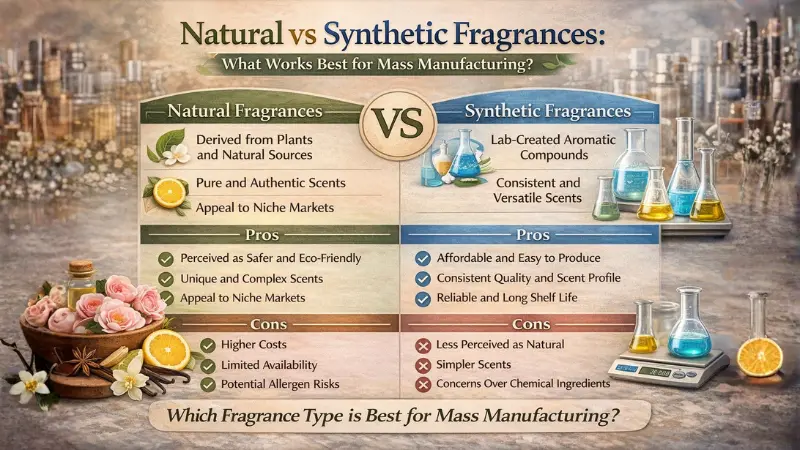
If you're making products that go on skin, you absolutely need to understand natural vs synthetic fragrances and their safety profiles. "Natural" doesn't automatically mean "safer."
You walk into a high-end store, smell their bestselling candle, and think "I'll make something just like this!"
Two problems with this approach:
First, you're competing with an established brand that has massive marketing budgets. Second, you don't understand why that fragrance works for their brand and customer base.
What works for a luxury hotel brand might completely flop for your eco-friendly yoga studio line. Context matters.
How to Avoid It: Instead of copying, get inspired and adapt. If you love a high-end spa scent, analyze what makes it work:
Then create something that serves the same emotional need but feels authentic to your brand. Looking at top perfume manufacturers in Delhi NCR or Noida, you'll notice successful brands have unique scent signatures, not copies.
You created a heavy, warm, musky fragrance. Launched it in April. In Mumbai.
Nobody bought it. Why? Because when it's 38°C outside, people want fresh, light, cooling scents, not warm and heavy ones.
India has distinct regional and seasonal fragrance preferences that many small brands overlook. What sells in Shimla won't necessarily sell in Chennai. Summer preferences differ drastically from winter.
How to Avoid It: Plan your fragrance launches seasonally. Create lighter, fresher options for summer. Save warm, spicy scents for winter and festival season.
Regional considerations matter too:
Check out this seasonal fragrance guide to understand timing better.
Fragrances are delicate. Light, heat, and air are their enemies.
I've seen brands store fragrance oils in clear bottles on sunny shelves. Then wonder why their fragrances smell different after a few months. Or why their products have an off-smell.
Oxidation changes fragrance chemistry. UV light breaks down certain components. Temperature fluctuations cause separation.
How to Avoid It: Store fragrance oils properly:
When working with fragrances, keep them sealed when not in use. Don't leave caps off. Don't stick contaminated droppers back into bottles.
Treat your fragrance inventory like you'd treat expensive wine. Because that's essentially what it is.
Your product smells perfect today. But what about three months from now?
Small brands often skip long-term stability testing because they're eager to launch. Then customer complaints start rolling in:
How to Avoid It: Conduct proper stability testing before full production:
Accelerated Aging Test: Store samples at elevated temperature (40°C) for 2-4 weeks. This simulates months of normal storage.
Real-Time Testing: Keep samples at room temperature for 3-6 months. Check them monthly for changes.
Freeze-Thaw Testing: For products that might experience temperature changes during shipping.
Yes, this delays your launch. But it prevents the nightmare of massive returns and angry customers.
If you're working with detergent fragrances or fabric fragrances, stability is even more critical because these products interact with harsh cleaning chemicals.
This is the strategic mistake that kills brands slowly.
You create products without a clear fragrance philosophy. Your candle smells like vanilla. Your soap smells like lavender. Your lotion smells like rose. There's no connection, no story, no strategy.
Result? Customers don't understand your brand. You have no signature identity. You're just another random product in a crowded market.
How to Avoid It: Develop a fragrance strategy before you start formulating:
Define Your Scent Philosophy: What emotions do you want to evoke? Relaxation? Energy? Luxury? Nostalgia?
Create a Scent Family: Choose 3-5 related fragrance profiles that work together. Maybe you're all about "coastal freshness" or "Indian botanicals" or "minimal zen."
Build Recognition: Develop one signature scent that appears across multiple products. This becomes your brand identifier.
Tell the Story: Every fragrance should have a reason for existing in your line. "We added this because customers asked for it" isn't a strategy.
Brands like successful private label fragrance manufacturers understand this. They help you build a cohesive collection, not random products.
Let me tell you about Mira's story. She launched a skincare brand with five products, five different fragrances, all chosen randomly.
Sales were okay but not great. Customer retention was terrible. She couldn't figure out why.
Then she worked with a fragrance consultant who helped her:
Within six months, repeat purchases jumped 40%. Customers started saying "I love your brand's smell." That's when she knew she got it right.
The cost? About ?1.2 lakhs for professional help. The alternative? Continuing to waste money on products that didn't connect.
Successful small brands with great fragrance formulation share these traits:
They Start Small: Test with 100-200 units before committing to thousands.
They Test Relentlessly: In actual products, with real customers, over time.
They Partner Smart: Work with experienced fragrance manufacturers who guide them.
They Document Everything: What works, what doesn't, why.
They Listen More Than They Assume: Customer feedback beats founder intuition.
They Stay Compliant: Proper documentation, testing, labeling from day one.
They Build Cohesively: Every fragrance fits into a larger brand story.
Starting a fragrance product line? Here's how to do it right:
Month 1: Research and Planning
Month 2: Development
Month 3: Testing
Month 4: Soft Launch
Month 5+: Scale
This timeline feels slow when you're excited to launch. But it prevents the expensive disasters that kill small brands.
Fragrance formulation isn't rocket science, but it's not guessing either. It's a craft that combines chemistry, artistry, and business strategy.
The small brands that succeed are the ones that:
The brands that fail? They treat fragrance as an afterthought. They cut corners to save money upfront. They skip the boring stuff like testing and compliance. Then they wonder why their beautiful products don't sell or generate returns.
You don't need a massive budget to get fragrance formulation right. You need patience, the right partners, and a willingness to test before you scale.
Every mistake I've listed here is completely avoidable. Other small brands paid the tuition. Learn from them, not by repeating their errors.
How much should a small brand budget for fragrance formulation?
Expect ?50,000-2 lakhs for professional development including formulation, testing, and small initial production runs. Trying to do it for less usually means cutting corners that cost more later. Working with established perfume manufacturers in India can help optimize costs.
Can I create fragrances using only essential oils?
Yes, but it's challenging. Natural essential oils are expensive, can be unstable, and some are skin sensitizers. Most successful small brands use a blend of natural and safe synthetic ingredients for better performance and consistency.
What's the minimum order quantity for custom fragrance formulation?
Most manufacturers require 500-1,000 units minimum, though some work with smaller test batches of 100-200 units. The smaller the batch, the higher the per-unit cost. Factor this into your budget.
How long does professional fragrance development take?
From initial concept to final formulation, expect 2-4 months. Rushed formulation leads to mistakes. Good manufacturers won't cut corners on testing and stability checks.
Do I need different fragrances for different product types?
Not necessarily. A well-formulated fragrance can work across candles, soaps, and lotions, though concentration will vary. However, some notes perform better in certain applications. Your manufacturer should guide these decisions.
What certifications do I need for fragrance products in India?
You need IFRA compliance certificates, safety data sheets (SDS), and cosmetic product licenses from your state authority. Requirements vary by product type and state. Don't skip this—non-compliance has legal consequences.
Ready to create fragrances the right way? Contact us to discuss your fragrance formulation needs. With over 35 years of experience and expertise in everything from soap fragrances to fine fragrances, we help small brands avoid costly mistakes and create products customers love. Visit JK Aromatics to explore our services.

Partner with JK Aromatics for innovative fragrance solutions that elevate your brand and delight your customers. Our team of experts is ready to bring your vision to life.