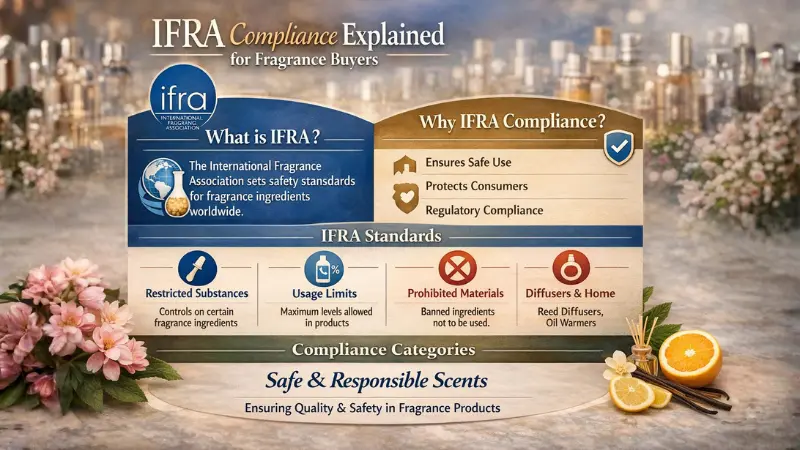
The International Fragrance Association: Global Safety Leadership
The International Fragrance Association (IFRA) is the global representative body of the fragrance industry, representing the collective interests of fragrance manufacturers and suppliers worldwide. Founded in 1973, IFRA's primary mission is to ensure the safety of fragrance materials and promote responsible practices throughout the fragrance supply chain.
IFRA's Core Functions:
Safety Standards Development: IFRA establishes and maintains the IFRA Standards, a comprehensive framework of usage restrictions and prohibitions for fragrance ingredients based on rigorous safety assessments conducted by the independent Research Institute for Fragrance Materials (RIFM).
Scientific Research Coordination: IFRA works closely with RIFM to evaluate the safety of fragrance ingredients through extensive toxicological, dermatological, and environmental studies, ensuring standards reflect the latest scientific knowledge.
Industry Self-Regulation: IFRA Standards represent a robust self-regulatory system that often exceeds legal requirements, demonstrating the fragrance industry's proactive commitment to consumer safety.
Global Harmonization: By providing internationally recognized standards, IFRA facilitates regulatory compliance across multiple markets, simplifying quality assurance for manufacturers operating globally.
Transparency & Communication: IFRA promotes transparency about fragrance ingredients and safety, helping build consumer confidence and supporting informed decision-making throughout the supply chain.
Comprehensive Safety Framework for Fragrance Materials
IFRA Standards consist of detailed restrictions and prohibitions on the use of specific fragrance ingredients in consumer products. These standards are based on extensive scientific research and are updated regularly to incorporate new safety data.
How IFRA Standards Work:
Product Categories: IFRA divides consumer products into 12 distinct categories based on their application and level of skin contact:
Usage Restrictions: For each fragrance ingredient, IFRA specifies maximum usage levels (expressed as percentages) permitted in each product category. These limits are based on safety assessments considering exposure routes, contact duration, and vulnerable populations.
Prohibitions: Some ingredients are completely prohibited due to safety concerns, regardless of concentration or application.
Specifications: IFRA Standards may include purity requirements, impurity limits, or specific technical specifications for certain fragrance materials.
Regular Updates: IFRA Standards are revised periodically (typically twice per year) as new safety data becomes available, ensuring ongoing protection based on current scientific understanding.
Critical Benefits for Fragrance Buyers
Consumer Safety: IFRA compliance ensures fragrance ingredients are used at levels proven safe for human health, minimizing risks of allergic reactions, skin sensitization, and other adverse effects. This protects your end consumers and demonstrates your commitment to their wellbeing.
Regulatory Compliance: Many countries and regions reference IFRA Standards in their cosmetic and consumer product regulations. IFRA-compliant fragrances simplify compliance with regulations in the European Union (Cosmetics Regulation), United States (FDA), India (Drugs and Cosmetics Act), and numerous other markets.
Risk Mitigation: Using IFRA-compliant fragrances reduces legal, financial, and reputational risks associated with product recalls, consumer complaints, regulatory penalties, and potential litigation related to safety issues.
Market Access: Major retailers, distributors, and brands increasingly require IFRA compliance as a condition for product acceptance. Compliance opens doors to premium markets and sophisticated distribution channels.
Brand Protection: Demonstrating commitment to internationally recognized safety standards strengthens brand reputation, builds consumer trust, and differentiates your products in competitive markets.
Quality Assurance: IFRA compliance reflects rigorous quality management systems, technical expertise, and professional standards throughout your fragrance supply chain.
Supply Chain Transparency: IFRA Certificates of Conformance provide documented evidence of compliance, supporting traceability and accountability requirements in modern supply chains.
Insurance & Liability: Using compliant fragrances may positively impact product liability insurance considerations and strengthen your defense in the unlikely event of safety-related claims.
Research Institute for Fragrance Materials (RIFM)
IFRA Standards are based on rigorous scientific research conducted by RIFM, an independent nonprofit organization dedicated to evaluating fragrance ingredient safety through comprehensive studies.
RIFM's Research Methodology:
Toxicological Studies: Comprehensive evaluation of potential adverse health effects including acute toxicity, repeated dose toxicity, reproductive toxicity, genotoxicity, and carcinogenicity.
Dermatological Testing: Extensive skin safety assessments including sensitization potential, irritation, and phototoxicity (reaction to sunlight exposure).
Environmental Impact: Assessment of environmental fate, aquatic toxicity, and biodegradability to ensure responsible environmental stewardship.
Exposure Assessment: Detailed analysis of consumer exposure levels based on product types, application methods, frequencies of use, and vulnerable populations.
Risk Characterization: Integration of hazard data and exposure assessment to determine safe use levels through scientifically sound risk assessment methodologies.
Expert Panel Review: All research undergoes independent scientific review by the RIFM Expert Panel, comprising internationally recognized experts in toxicology, dermatology, and related fields.
Quantitative Risk Assessment (QRA): RIFM employs sophisticated QRA methodologies that calculate safe exposure levels based on margins of safety, considering all available scientific data and incorporating appropriate safety factors.
This scientific rigor ensures IFRA Standards reflect evidence-based safety assessments rather than arbitrary restrictions, providing credible protection for consumers worldwide.
Documentation That Proves Compliance
An IFRA Certificate of Conformance is an official document issued by fragrance manufacturers declaring that a specific fragrance composition complies with current IFRA Standards for designated product categories.
What IFRA Certificates Include:
Fragrance Identification: Complete identification of the fragrance composition including product name, code number, and version.
Applicable Standards: Reference to the specific IFRA Standards amendment (e.g., 51st Amendment) against which compliance is declared.
Product Categories: Clear indication of which IFRA product categories the fragrance is suitable for, with any usage restrictions specified.
Restricted Materials: Declaration of presence and maximum allowable usage levels for restricted fragrance ingredients.
Prohibited Materials: Confirmation that prohibited ingredients are not present in the composition.
Allergens Declaration: Information on the presence of allergens requiring labeling under various regulations (e.g., EU Cosmetics Regulation Annex III).
Usage Recommendations: Maximum recommended usage levels for each applicable product category to maintain compliance.
Validity & Updates: Certificate version, issue date, and notification of any subsequent updates or amendments.
Manufacturer Declaration: Official declaration signed by authorized personnel confirming accuracy and compliance.
How to Use IFRA Certificates:
Your Trusted Partner for Compliant Fragrances
At JK Aromatics & Perfumers, IFRA compliance is non-negotiable. Every fragrance we develop and supply meets current IFRA Standards, providing you with peace of mind and regulatory confidence.
Our IFRA Compliance Process:
Ingredient Screening: Every raw material entering our facility is screened against current IFRA Standards before acceptance. We maintain an updated database of restricted and prohibited materials.
Formulation Controls: Our master perfumers formulate fragrances with built-in compliance, ensuring all compositions meet IFRA requirements from inception rather than requiring post-development adjustments.
Automated Compliance Checking: We employ specialized fragrance management software that automatically calculates IFRA compliance for each formulation across all 12 product categories, identifying any potential issues before production.
Regular Standards Updates: Our technical team monitors IFRA amendments and updates our systems, formulations, and documentation promptly to maintain ongoing compliance with the latest standards.
Certificate Generation: We provide comprehensive IFRA Certificates of Conformance for all fragrances, clearly documenting compliance status, usage restrictions, and allergen information.
Technical Support: Our team assists customers with interpreting IFRA certificates, determining appropriate usage levels, and addressing any compliance questions or concerns.
Documentation Management: We maintain complete traceability and documentation supporting our compliance declarations, available for audit or regulatory review if required.
Continuous Improvement: We actively participate in industry discussions about fragrance safety and incorporate evolving best practices into our quality management systems.
Q: Are IFRA Standards legally mandatory? A: IFRA Standards themselves are not laws, but they are widely referenced in regulations and are considered industry best practice. Many countries incorporate IFRA Standards into their legal frameworks, and major retailers often require IFRA compliance contractually.
Q: How often do IFRA Standards change? A: IFRA typically publishes amendments twice per year (usually in June and December), though not every amendment introduces new restrictions. Major comprehensive reviews occur periodically.
Q: What happens if an ingredient becomes restricted after I've formulated my product? A: Manufacturers typically have a transition period to reformulate products when new restrictions are introduced. Your fragrance supplier should notify you of changes affecting your formulations and offer compliant alternatives.
Q: Can natural fragrances be non-compliant? A: Yes. Natural essential oils and extracts contain numerous chemical components, some of which may be restricted or prohibited under IFRA Standards. "Natural" does not automatically mean "safe" or "compliant."
Q: How do I know what IFRA category my product belongs to? A: IFRA provides detailed category definitions. Your fragrance supplier can help determine the appropriate category based on your product's application and consumer use. Some products may fall into multiple categories.
Q: What if I want to use a fragrance at a higher level than recommended? A: Usage levels in IFRA certificates represent maximum safe levels for compliance. Exceeding these levels may result in non-compliance with safety standards and regulatory requirements. Always stay within recommended limits.
Q: Do I need to test my finished product if I use IFRA-compliant fragrances? A: IFRA compliance addresses fragrance ingredient safety, but finished product safety may require additional considerations including interactions with other ingredients, product pH, packaging, and intended use. Consult regulatory experts for comprehensive guidance.
Q: How do I stay informed about IFRA changes affecting my products? A: Partner with reputable fragrance suppliers like JK Aromatics who monitor IFRA updates and proactively communicate changes affecting your formulations. You can also subscribe to IFRA communications directly.
Exceeding Standards for Your Success
While IFRA compliance is our baseline, JK Aromatics goes further to ensure exceptional quality and safety:
Additional Quality Measures:
? ISO Certification: Our facilities maintain ISO 9001 (Quality Management), ISO 14001 (Environmental Management), and ISO 45001 (Occupational Health & Safety) certifications.
? Allergen Management: Comprehensive allergen tracking and documentation supporting labeling requirements across multiple regulatory jurisdictions.
? Stability Testing: Rigorous testing ensures fragrances maintain compliance throughout product shelf life, not just at manufacturing.
? Compatibility Assessment: Evaluation of fragrance performance and safety in your specific formulation matrix.
? Regulatory Intelligence: Ongoing monitoring of global regulatory developments affecting fragrance usage in various markets.
? Halal Certification: For customers requiring religiously compliant ingredients, we offer Halal-certified fragrance options.
? Custom Compliance Solutions: Tailored fragrance development meeting specific regulatory requirements for specialized applications or markets.
Safe Fragrance Solutions Across Applications
Personal Care & Cosmetics: Perfumes, colognes, body lotions, creams, deodorants, hair care products, shampoos, conditioners, styling products, skincare formulations, facial care, makeup products
Home Care: Detergents, fabric softeners, surface cleaners, dishwashing products, air fresheners, toilet cleaners, laundry care, household cleaners
Fine Fragrance: Eau de parfum, eau de toilette, cologne, body mists, luxury perfumes, niche fragrances
Personal Hygiene: Soaps, body washes, hand washes, sanitizers, oral care products, shaving products, bath products
Candles & Home Fragrance: Scented candles, wax melts, reed diffusers, room sprays, potpourri, incense products
Industrial Applications: Plastics odour masking, rubber products, cleaning chemicals, specialty formulations
Each application requires careful consideration of IFRA category and usage restrictions. Our team ensures your fragrances comply with requirements specific to your products.
Partner with Confidence
Ready to source safe, compliant fragrances for your products? JK Aromatics & Perfumers makes IFRA compliance simple and straightforward.
Our Process:
1. Consultation: Discuss your product category, application, target market, and specific compliance requirements.
2. Fragrance Selection: Choose from our extensive portfolio of IFRA-compliant fragrances or request custom development.
3. Documentation: Receive comprehensive IFRA Certificates of Conformance and supporting technical documentation.
4. Technical Guidance: Get expert advice on proper usage levels, formulation considerations, and labeling requirements.
5. Ongoing Support: Benefit from proactive communication about standards updates and continuous technical assistance.
What We Need From You:
Contact Us Today:
???? Phone: +91-9625774388
???? Email: info@jkaromatics.com
???? Address: E-148, Sector A-7, Part-1, Trans Delhi Signature City, Loni - 201103, Distt Ghaziabad, Uttar Pradesh
Expand Your Knowledge
IFRA Official Resources:
Regulatory References:
Industry Publications:
JK Aromatics Resources:
Compliance as Competitive Advantage
Understanding and implementing IFRA compliance isn't just about meeting regulatory requirements—it's about demonstrating your commitment to consumer safety, product quality, and professional excellence. By partnering with JK Aromatics & Perfumers, you gain access to IFRA-compliant fragrances backed by 35+ years of expertise, rigorous quality systems, and unwavering dedication to safety standards.
Let us handle the complexities of IFRA compliance so you can focus on creating exceptional products that consumers love and trust. Together, we'll ensure your fragrances meet the highest safety standards while delivering the sensory experiences that make your products stand out.
Your success is built on safety, quality, and compliance—and we're here to support you every step of the way.
This comprehensive content educates fragrance buyers about IFRA compliance while positioning JK Aromatics as a knowledgeable, reliable partner committed to safety and quality. The content balances technical accuracy with accessibility, making complex regulatory topics understandable for buyers at all expertise levels.
Partner with JK Aromatics for innovative fragrance solutions that elevate your brand and delight your customers. Our team of experts is ready to bring your vision to life.