How to Start an Agarbatti Manufacturing Business in India: A Complete Guide
How to Start an Agarbatti Manufacturing Business in India: A Comprehensive B2B Guide
The agarbatti (incense stick) manufacturing sector in India represents a robust, culturally significant, and commercially viable industry. Driven by deep-rooted spiritual traditions and a growing demand for home fragrance and wellness products, the market is expanding both domestically and internationally. For B2B partners, success hinges not just on efficient production but on technical mastery, especially in the art and science of scent creation. This guide, informed by decades of expertise in fragrance development, outlines the strategic and operational steps required to establish an authoritative and successful agarbatti manufacturing business in India.
Understanding the Indian Agarbatti Market: Potential and Trends
The Indian incense sticks and dhoop market is valued between INR 7,000 crore and INR 12,000 crore, with significant growth projected in the coming years (CAGR between 5.09% and 8.8% through 2034). Agarbatti, as a product format, dominates the market, accounting for approximately 74.5% of the total incense segment.
Market Drivers and Segmentation
- Spiritual and Religious Use: This remains the core market driver, ensuring a consistent, non-discretionary demand base in nearly 82% of Indian households.
- Home Fragrance and Wellness: Increasing urban and rural demand for products used in meditation, relaxation, and general home ambiance is fueling market expansion. Consumers are seeking unique, functional, and therapeutic fragrances.
- Export Opportunities: India is a major exporter of agarbatti, shipping to over 125 countries. Meeting global compliance standards is crucial for leveraging this growing international demand.
Emerging Trends in Product Development
Modern manufacturers must innovate to stay competitive. Key emerging trends include:
- Premiumization: A shift toward high-end packaging, unique perfume notes, and products marketed for their aromatherapy benefits.
- Clean-Label and Natural Formulations: Growing demand for charcoal-free, herbal, and natural-based products, often using essential oils and natural binders.
- Functional Fragrances: Products with added benefits, such as mosquito-repellent variants, are expanding the use case beyond traditional religious practices.
The Critical Role of Fragrance Quality and Compliance
For any agarbatti manufacturer, the fragrance compound is the key differentiator and the primary technical challenge. Partnering with a heritage fragrance house like JK Aromatics, established in 1989, provides access to deep expertise in fragrance stability, diffusion, and compliance.
IFRA Compliance and BIS Standards
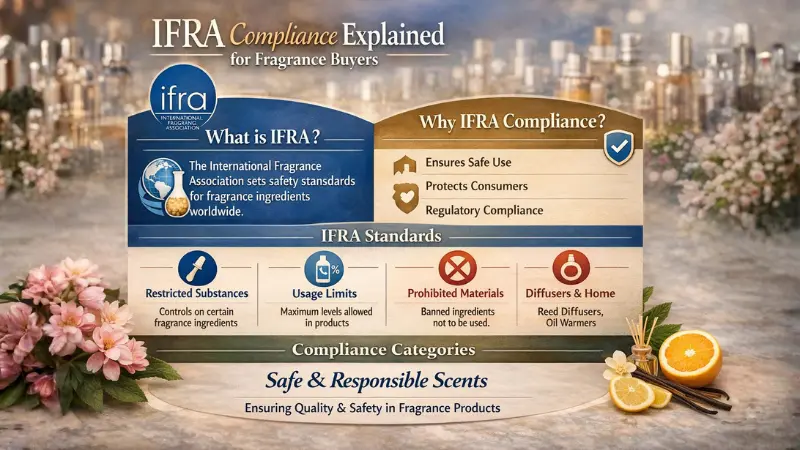
Product safety is paramount. The International Fragrance Association (IFRA) sets global safety standards for fragrance ingredients. Compliance with IFRA standards is mandatory for export and is now being integrated into domestic regulations.
- BIS Standard IS 19412:2025: India's Bureau of Indian Standards (BIS) released IS 19412:2025, which, while currently voluntary, is expected to become a mandatory safety framework. This standard explicitly mandates that all fragrance compounds used in agarbatti must comply with IFRA safety guidelines.
- The Declaration of Conformity: Your fragrance supplier, not IFRA, issues the Declaration of Conformity. This document is essential proof that your fragrance is safe for its intended application—a critical factor for building a trustworthy brand and ensuring compliance with the latest global and domestic standards.
Fragrance Technical Performance
High-performance fragrances must be stable and effective throughout the product lifecycle:
- Base Compatibility: The fragrance compound must not react negatively with the base powder mixture (charcoal, jigat, wood powder) or the DPG solvent used for dipping.
- Heat Stability: Fragrances must be formulated to withstand the heat generated during manufacturing (if applicable) and, more importantly, to perform optimally during the burning process.
- Fragrance Throw and Longevity: The compound needs the technical characteristics to ensure a pleasant, consistent scent diffusion (throw) while burning, and to maintain a long-lasting impression (substantivity) in the environment.
Expert Takeaway: Avoid the mistake of prioritizing cost over compliance in fragrance sourcing. Poorly formulated fragrances can accelerate regulatory scrutiny, lead to ingredient blacklisting, and severely damage brand trust. A B2B partner like JK Aromatics provides a Certificate of Conformity with IFRA Standards, ensuring that your raw material is technically sound and legally compliant. For further reading, consult our guide on
Top Agarbatti Fragrance Oil Suppliers India to understand key selection criteria.
Essential Raw Materials and Manufacturing Process
The agarbatti process involves combining the base components, applying the binding mixture to the bamboo core, drying, scenting, and packaging.
Key Raw Materials Sourcing
Sourcing high-quality raw materials is non-negotiable for product performance and adherence to BIS standards.
- Bamboo Sticks: The foundational core. Must be uniform, dry, and pest-free.
- Base Powders: The mixture typically consists of Charcoal Powder (for burning/fuel), Wood Powder/Sawdust (as filler/bulk), and Jigat Powder (the natural binder from the Litsea glutinosa bark).
- Fragrance Solution: The aromatic compound (fragrance oil) is typically blended with a solvent like Di-Propylene Glycol (DPG) to create the dipping solution. The selection of the fragrance oil dictates the final product's quality, diffusion, and market appeal. Manufacturers should explore diverse scent profiles, as detailed in our analysis of Agarbatti Fragrance Oil Supplier India | Popular Scents.
- Packaging Materials: Quality packaging is essential to protect the volatile fragrance oils and maintain the product's shelf life and premium perception.
Choosing the Right Manufacturing Scale
The scale of production will determine the required investment, machinery, and reliance on labor.
| Scale |
Production Method |
Initial Investment Range |
Primary Benefit |
| Small / Home-Based |
Manual rolling/Low-capacity semi-automatic machines |
INR 20,000 to INR 50,000 |
Low entry barrier; ideal for testing niche markets. |
| Medium / Semi-Automatic |
Semi-automatic agarbatti making machines (coating/forming) |
INR 1.5 Lakh to INR 4 Lakh |
Increased output (15-20 kg/day) and better consistency. |
| Large / Automatic |
High-speed fully automatic machines |
INR 5 Lakh and above |
Mass production, cost efficiency, and uniform product quality. |
Expert Takeaway: Fragrance loss during the dipping and drying stages is a common and costly issue. Use high-quality DPG and ensure your base powder is fully dry before dipping. The optimal drying process—a controlled environment over 24 to 48 hours—is essential for maximizing the blooming (full scent expression) and substantivity (scent retention) of the fragrance compound. Partner with a fragrance developer who can advise on the ideal concentration and solvent choice for maximum fragrance throw.
Regulatory and Legal Framework in India
Establishing a legally compliant manufacturing unit requires adhering to several essential registrations and licenses.
Business Structure and Registration
- Business Entity Registration: Choose a structure (Sole Proprietorship, Partnership Firm, LLP, or Private Limited Company) and register the entity.
- GST Registration: Mandatory for businesses exceeding the turnover threshold for goods (HSN Code 3307 is typically applicable, with a GST rate of approximately 12%).
- MSME/Udyam Registration: While not mandatory, registering under the Ministry of Micro, Small and Medium Enterprises (MSME) can provide access to government schemes, subsidies, and financing options.
- Trade License: Obtain a trade license from the local municipal corporation or governing body.
Compliance and Certifications
- Pollution Control Board (PCB) NOC: An agarbatti unit, especially if using a diesel generator or operating at scale, often requires a No Objection Certificate (NOC) from the State Pollution Control Board. Compliance with environmental regulations is crucial for operational longevity.
- Factory License: Required for larger commercial operations and depending on the number of employees and use of power.
- ESI & EPF Registration: Mandated for businesses with a specific number of employees (ESI: 10 or more, EPF: 20 or more).
Strategic Partnership for Long-Term Success
For a new entrant, the greatest challenge is balancing production efficiency with high-quality, market-responsive products. This is where a strategic B2B partner becomes invaluable.
JK Aromatics & Perfumers, with its philosophy of "Creating Sensorial Dreams Since 1989," acts as a critical formulation partner for agarbatti manufacturers. Our role extends beyond merely supplying fragrance oils; it involves technical consultation on heat stability, dosage optimization, base compatibility, and ensuring compliance with evolving standards like the BIS IS 19412:2025.
By establishing a B2B relationship, you gain access to decades of scent science and application knowledge, allowing your manufacturing unit to focus on distribution and branding while we ensure the sensory integrity and compliance of your product line. Understanding this symbiotic relationship is key to long-term profitability and sustainable growth in the competitive home fragrance sector, as outlined in our comprehensive guide on Profitable Home Fragrance Manufacturing.
Related reading