Decoding the Indian Fragrance Landscape: Supplier vs. Manufacturer
For businesses looking to source fragrances in India, the terms 'fragrance supplier' and 'fragrance manufacturer' are often used interchangeably. However, understanding the distinct roles and services offered by each is paramount for making informed decisions that align with your product development, branding, and budget. Whether you're a burgeoning startup or an established enterprise, choosing the right partner can significantly impact your product's quality, uniqueness, and market success.
India's fragrance market is dynamic, rich with traditional perfumers, innovative manufacturers, and a vast network of distributors. This guide will meticulously break down the differences between fragrance suppliers and manufacturers, highlighting their respective advantages and disadvantages, especially pertinent for the Indian context.
What is a Fragrance Manufacturer?
A fragrance manufacturer is at the heart of the creation process. They are the alchemists who blend various raw materials – natural essential oils, aroma chemicals, and other synthetic compounds – to create unique fragrance compounds (also known as fragrance oils or perfume oils). Their core expertise lies in research, development, and the meticulous art of formulation.
Key Characteristics & Activities:
- Formulation & R&D: Manufacturers possess dedicated R&D teams and perfumers who conceptualize, test, and refine scent profiles from scratch. They can work on specific briefs, creating custom fragrances tailored to a brand's unique requirements, target audience, and product application (e.g., cosmetics fragrances, fine fragrances, industrial applications).
- Blending & Production: They handle the entire production process, from sourcing individual aroma ingredients to blending them in precise ratios, ensuring consistency across batches. This involves sophisticated machinery and adherence to strict quality control measures.
- Quality Control (QC): Manufacturers implement rigorous QC protocols at every stage, from raw material inspection to finished product testing, ensuring the fragrance's stability, safety, and adherence to specified parameters.
- Regulatory Compliance: Operating in a highly regulated industry, manufacturers are well-versed in local and international fragrance standards (e.g., IFRA guidelines, Indian regulatory bodies). They ensure their formulations comply with these standards, which is crucial for product safety and market entry, especially for products like detergent fragrances.
- Customization: This is a major differentiator. Manufacturers can develop exclusive, proprietary scents, offering brands a unique selling proposition and protecting their intellectual property.
- Bulk Production: They are equipped for large-scale production, making them ideal for businesses with high volume requirements.
Advantages of Working with a Manufacturer:
- Unique Identity: Develop exclusive scents that truly differentiate your brand.
- Quality Assurance: Direct control over the entire production process ensures consistent quality and adherence to specific standards.
- Cost Efficiency (Large Volumes): For significant order quantities, manufacturing directly can be more cost-effective per unit.
- Technical Support: Access to expert perfumers and R&D teams for formulation advice, troubleshooting, and innovation.
- Scalability: Ability to scale up production to meet growing market demand.
Disadvantages of Working with a Manufacturer:
- Higher Minimum Order Quantities (MOQs): Typically require larger initial orders, which might be a barrier for small businesses or startups.
- Longer Lead Times: Custom formulation and production can involve longer development and delivery timelines.
What is a Fragrance Supplier?
A fragrance supplier, on the other hand, acts as an intermediary. They source pre-formulated fragrance compounds from one or multiple manufacturers and then distribute them to various businesses. Think of them as a curated marketplace for existing fragrance solutions.
Key Characteristics & Activities:
- Sourcing & Distribution: Their primary role is to procure a diverse range of fragrance oils from different manufacturers and then supply them to customers.
- Warehousing & Logistics: They manage inventory, storage, and timely delivery of fragrances.
- Off-the-Shelf Solutions: Suppliers typically offer a catalog of ready-made, standard fragrance profiles, often popular or generic scents suitable for various applications.
- Smaller Quantities: They are often more accommodating to lower MOQs, catering to smaller businesses, artisans, or those testing new product lines.
- Market Insights: A good supplier might have broad market knowledge, offering insights into popular scent trends and readily available options.
Advantages of Working with a Supplier:
- Lower MOQs: Accessible for smaller businesses, startups, or experimental projects.
- Quicker Delivery: Since products are off-the-shelf, lead times are generally shorter.
- Wider Selection: Can offer a broad portfolio of fragrances from various manufacturers, providing diverse options without committing to custom development.
- Convenience: A one-stop shop for diverse fragrance needs.
Disadvantages of Working with a Supplier:
- Limited Customization: Generally, no ability to create bespoke scents. You choose from existing options.
- Higher Unit Cost (for bulk): While MOQs are lower, the per-unit cost for very large volumes might be higher compared to direct manufacturing.
- Less Direct Control: Less insight or influence over the exact formulation, raw material quality, or the manufacturing process itself.
- Potential for Generic Scents: Reliance on standard scents might make it harder for a brand to stand out uniquely.
Key Differences Summarised: Manufacturer vs. Supplier
To further clarify, here's a comparative overview:
| Feature |
Fragrance Manufacturer |
Fragrance Supplier |
| Primary Role |
Creates new fragrance compounds |
Distributes existing fragrance compounds |
| Customization |
High degree (bespoke formulations) |
Low (selection from catalog) |
| Minimum Order Quantity (MOQ) |
Higher, suitable for bulk orders |
Lower, suitable for smaller batches |
| Pricing Model |
More competitive for high volumes |
Generally higher per unit, especially for bulk |
| Lead Time |
Longer (due to R&D, formulation, production) |
Shorter (off-the-shelf products) |
| Intellectual Property |
Can develop proprietary scents |
No ownership of fragrance formulation |
| R&D & Technical Support |
Extensive in-house expertise |
Limited or indirect technical support |
| Ideal For |
Brands seeking unique identity, large scale production, specific regulatory needs |
Small businesses, startups, testing markets, diverse range with lower commitment |
When to Choose a Fragrance Manufacturer in India
Opting for a fragrance manufacturer is beneficial if your business objectives include:
- Developing a Unique Brand Identity: If you want your products to have a signature scent that sets them apart from competitors.
- Large-Scale Production: For businesses with high production volumes, manufacturers offer better economies of scale.
- Specific Performance Requirements: If your product needs a fragrance with particular stability, longevity, or interaction properties, a manufacturer can formulate it precisely.
- Strict Regulatory Needs: Industries with stringent regulations (e.g., pharmaceuticals, specific cosmetics fragrances) benefit from a manufacturer's expertise in compliance.
- Long-Term Partnership & Innovation: Building a relationship with a manufacturer allows for continuous innovation and product evolution.
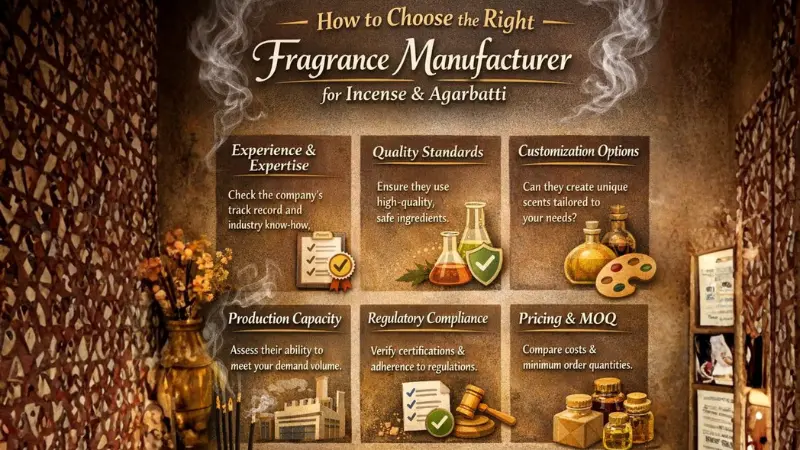
To delve deeper into selecting the right partner, consider reading our blog on how to choose the right fragrance manufacturer in India, which offers valuable insights and key questions to ask.
When to Choose a Fragrance Supplier in India
A fragrance supplier might be the better choice for:
- Startups and Small Businesses: When you need smaller quantities without a huge upfront investment.
- Market Testing: For trials, limited editions, or testing consumer preferences for various scent profiles without committing to a custom blend.
- Variety and Quick Turnaround: If you need a broad range of standard scents quickly for diverse product lines.
- Cost-Conscious Initial Stages: When budget constraints make custom formulation by a manufacturer prohibitive.
- Product Applications with Generic Scent Needs: For products where a highly unique scent isn't the primary differentiator.
The Indian Context: Nuances for Buyers
The Indian fragrance market presents unique opportunities and challenges. Factors to consider include:
- Local Preferences: Indian consumers often have distinct preferences for certain scent families (e.g., floral, woody, oriental). A local manufacturer will have a better understanding of these nuances than a global supplier.
- Raw Material Availability: India has a rich heritage of natural aromatics. Manufacturers here might have direct access to high-quality local raw materials, impacting cost and authenticity.
- Pricing and Logistics: Dealing with local manufacturers or suppliers often simplifies logistics and can result in more transparent pricing in INR, avoiding import duties and currency fluctuations.
- Regulatory Landscape: Navigating India's specific regulations for various product categories (e.g., home care, personal care, industrial products like detergent fragrances) is easier with a partner deeply entrenched in the local market.
Making the Right Choice for Your Business
The decision boils down to your specific business needs, product vision, scale of operations, and budget. Ask yourself these questions:
- Do I need a truly unique, proprietary scent? If yes, a manufacturer is your best bet.
- What are my production volumes? High volumes lean towards manufacturers; low volumes favor suppliers.
- How much am I willing to invest in R&D and product development? Manufacturers involve higher initial R&D costs.
- What is my desired lead time? Suppliers offer faster delivery for existing scents.
- How critical is deep technical support and regulatory guidance? Manufacturers excel here.
Conclusion
Understanding the fundamental differences between a fragrance supplier and a fragrance manufacturer is crucial for any business operating in India's vibrant aroma industry. While a manufacturer offers unparalleled customization, quality control, and long-term strategic partnership for unique product development and large-scale production, a supplier provides convenience, speed, and a diverse range of off-the-shelf options suitable for smaller enterprises or market testing.
By carefully evaluating your business model, product strategy, and specific requirements, you can select the right partner to help your brand flourish and captivate consumers with the perfect scent. Both play vital roles, but their strengths cater to different stages and scales of a business journey in the exciting world of fragrances.